
Study #14
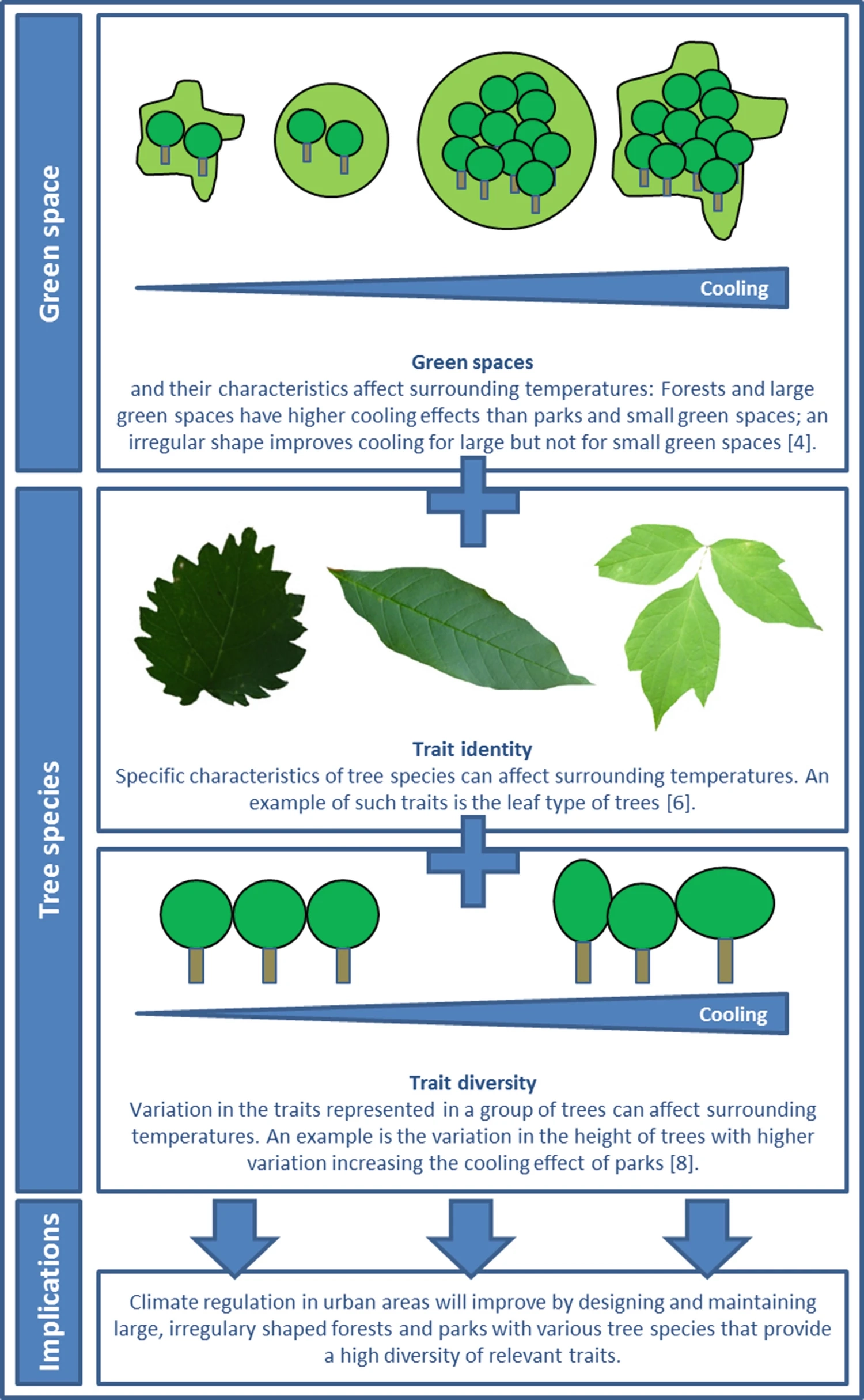
Figure: Summary of findings on the effects of green space configuration and tree diversity on climate regulation that should be considered when creating new urban green spaces, based on our own studies in the city of Leipzig [4, 8] and a study in the city of Basel, Switzerland [6]
STUDIES
2026-02-06
What can we learn from science? - Climate regulation by green spaces
In the late 2010s, scientists Sonja Knapp, Madhumitha Jaganmohan, and Nina Schwarz conducted a study in Leipzig, Germany, exploring how nature-based solutions (NBS)—specifically in over 60 urban green spaces—help cool cities.
Picture a hot summer day in the city. Asphalt radiates heat, buildings trap warmth, and people search for shade. The researchers walked through 60 parks and forests, measuring how air temperature changed from green spaces into nearby neighborhoods. What they discovered is a powerful lesson for climate-smart cities. Large green spaces and urban forests worked like natural air conditioners, cooling not just themselves but also surrounding streets. Surprisingly, it wasn’t simply the number of tree species that mattered. Instead, diverse tree structures—different heights, sizes, and shapes—made the biggest difference. A layered canopy with tall and smaller trees boosted shade and evapotranspiration, strengthening cooling effects.
The takeaway? For cities facing rising heat, bigger, well-designed, and structurally diverse green spaces are one of our strongest nature-based solutions. Smart tree choices today can mean cooler, healthier cities tomorrow.
Knapp, S., Jaganmohan, M., & Schwarz, N. (2019). Climate regulation by diverse urban green spaces: Risks and opportunities related to climate and land use change. In M. Schröter et al. (Eds.), Atlas of ecosystem services (pp. 167–172). Springer.
https://doi.org/10.1007/978-3-319-96229-0_26