
Study #17
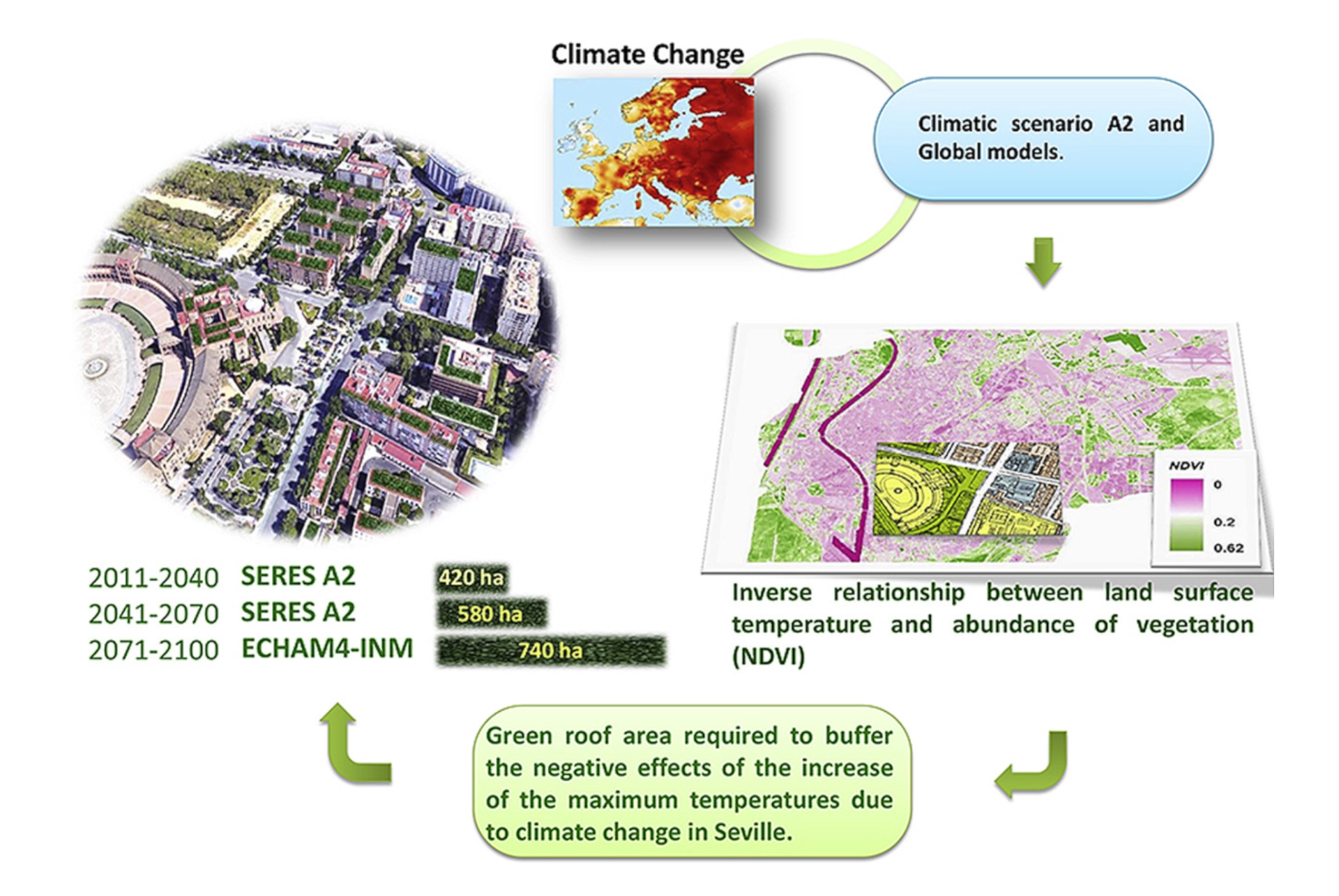
Figure: Climatic scenario A2 and Global models.
STUDIES
2026-02-23
What can we learn from science? - satelite and green roofs
In 2017, researchers Sergio S. Herrera-Gomez, Abel Quevedo-Nolasco and Luis Pérez-Urrestarazu from the University of Seville studied how green roofs could help cities fight climate change in Seville, Spain. What Did They Find? They discovered a clear inverse relationship (when one thing increases, the other decreases) between how much vegetation is on a roof and how hot the city surface becomes - more green means cooler ground. Let's imagine Seville’s rooftops turning from hot, baking tiles into lush, climate-smart oases. The scientists asked: How much green do we really need? Using satellite data, they found that in a worst-case climate scenario (with summer temperatures rising up to 6 °C), Seville would need about 740 hectares of green roofs - that’s nearly 40.6% of all buildings - to meaningfully offset the heat. In a more optimistic future, covering just 11.3% of roofs with vegetation could still make a big dent in rising city heat.
Greener rooftops aren’t just pretty - they’re part of a practical local strategy to cool cities and soften the blow of climate change.
Herrera-Gomez, S. S., Quevedo-Nolasco, A., & Pérez-Urrestarazu, L. (2017). The role of green roofs in climate change mitigation. A case study in Seville (Spain). Building and Environment, 123, 575-584.
https://doi.org/10.1016/j.buildenv.2017.07.036