
Study #19
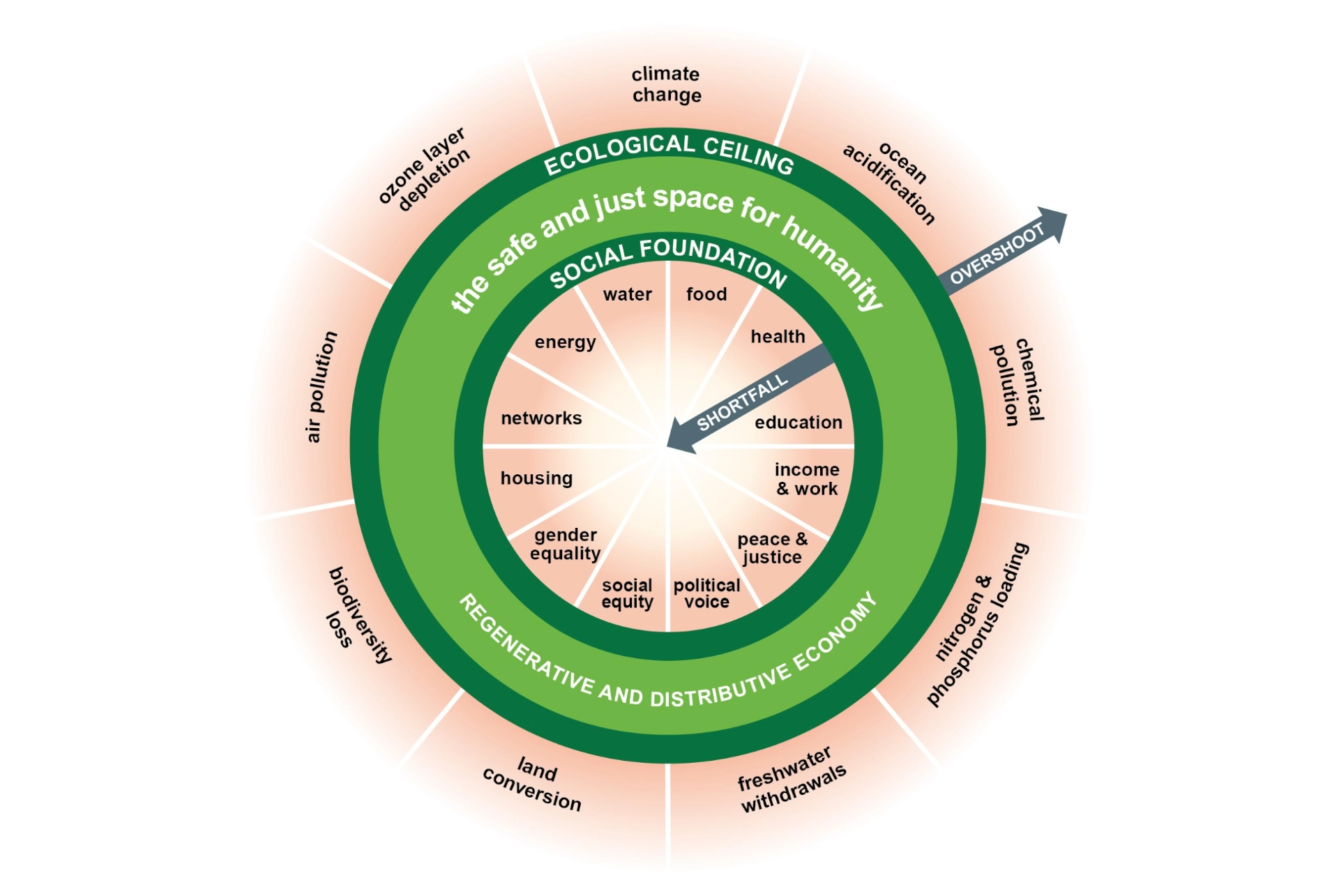
Figure: The Doughnut model.
STUDIES
2026-03-09
What can we learn from science? - doughnut economy
Today we have a sigligtly different turn on the Nature Based Solutions - an economical rethink. In April 2020, at Kaposvár University, economist Florian Ross published a conference paper in Regional and Business Studies examining Doughnut Economics: Seven Ways to Think Like a 21st-Century Economist by Kate Raworth. The study established that 20th-century growth-focused economics is pushing humanity beyond both social and planetary limits. Global warming is projected to rise 1.0-3.5°C by 2100, and people at risk from coastal flooding could jump from 75 million to 200 million. Meanwhile, GDP is expected to grow up to 5% annually-as if endless growth on a finite planet were possible.
Raworth’s “Doughnut Model” reframes the economy between 12 social foundations (like food, water, housing) and 9 planetary boundaries (like climate change and biodiversity loss). Right now? We’re overshooting both.
The message is bold: shift from infinite growth to a “safe and just space” where humanity and Earth thrive together. Not engineers chasing equilibrium-but gardeners nurturing balance. So the question is how can we use this theory today in implementing NBS? Comment your ideas.
Ross, F. (2020). Kate Raworth - Doughnut Economics: Seven Ways to Think Like a 21st Century Economist (2017). Regional and Business Studies, 11(2), 81–86.
https://doi.org/10.33568/rbs.2409