
Study #21
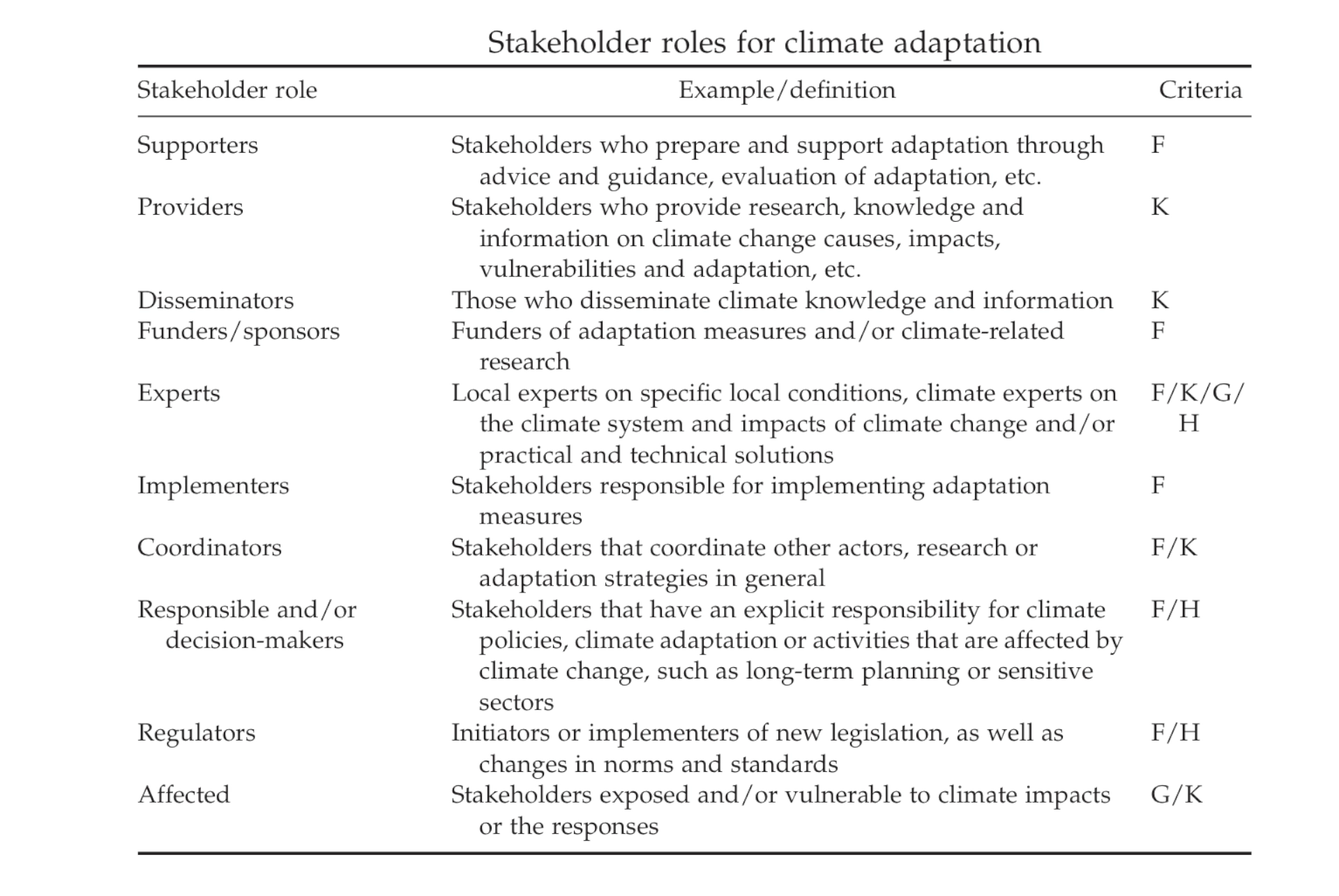
Figure: Stakeholder roles for climate adaptation.
STUDIES
2026-03-23
What can we learn from science? - identifying stakeholders
In 2012, researchers Karin André, Louise Simonsson, Åsa Gerger Swartling & Björn-Ola Linnér conducted a study in Stockholm and Gothenburg, Sweden, to uncover who matters most in climate adaptation planning and why. Their findings didn’t just map people - they revolutionized how we think about collaboration in climate action.
Using participatory mapping and case studies in two major Swedish urban regions, the team identified and categorized stakeholders involved in adapting to climate change. They asked local and regional actors who should be part of this effort and what roles they play in preparing for climate impacts.
20 stakeholders from 5 municipalities participated in focus groups, showing just how many voices are part of effective adaptation planning. Their method revealed distinct stakeholder types - from government bodies to private companies and community groups - each with unique responsibilities and influence. What's crucial here is that careful, systematic stakeholder analysis is essential for effective, flexible, and sustainable climate adaptation strategies.
Climate adaptation isn’t just a technical puzzle - it’s a people puzzle. By mapping who should be involved and how, we can build stronger, more inclusive cities and towns.
André, K., Simonsson, L., Swartling, Å. G., & Linnér, B.-O. (2012). Method development for identifying and analysing stakeholders in climate change adaptation processes. Journal of Environmental Policy & Planning, 14(3), 243–261.
https://doi.org/10.1080/1523908X.2012.702562