
Study #36
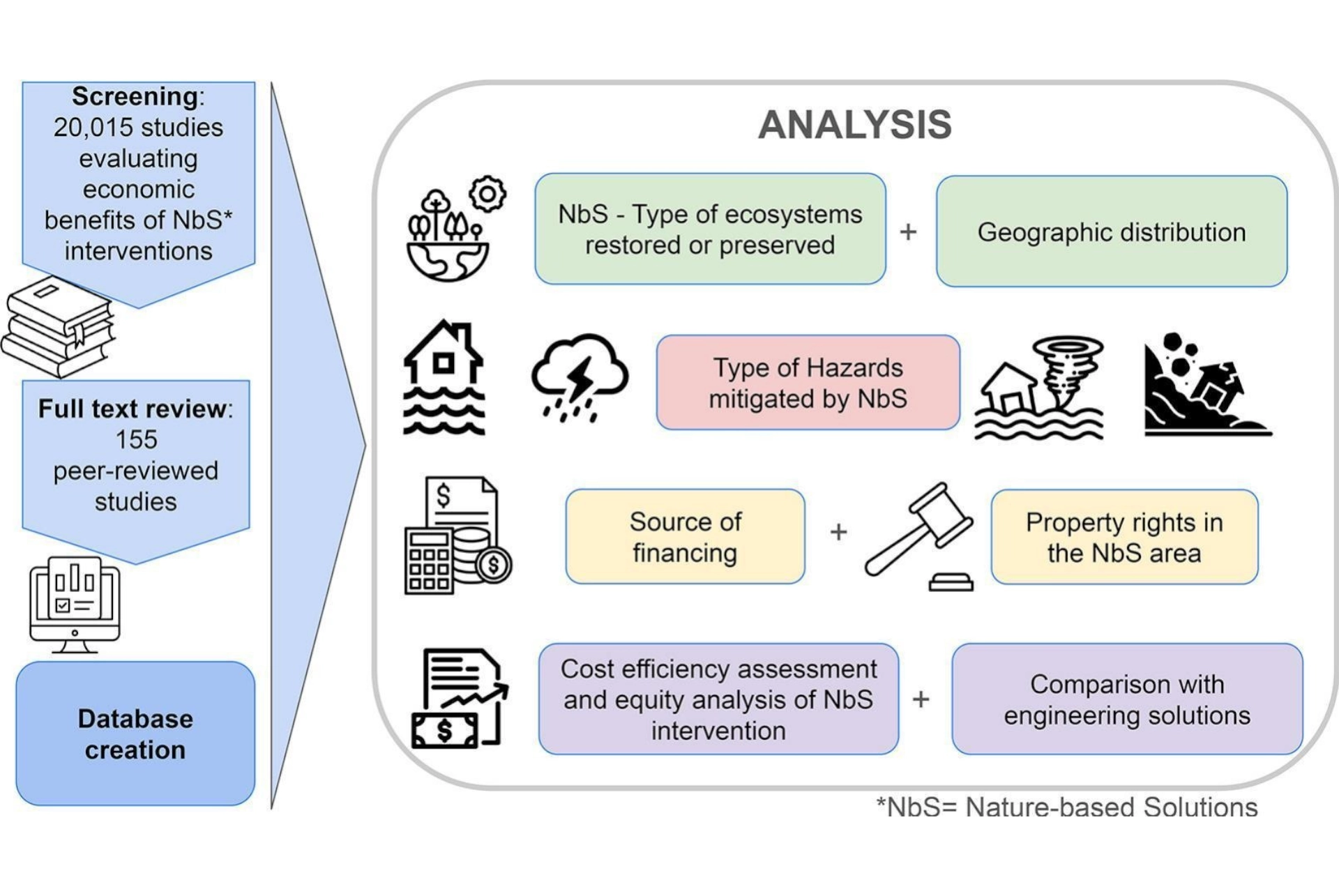
Figure: On the cost-effectiveness of Nature-based Solutions for reducing disaster risk - graphical abstract.
STUDIES
2026-07-15
Nature-based solutions insights - The Economics of Safeguarding Communities with Nature
In 2024, an international team of scientists from the University of Massachusetts Amherst (USA), the United Nations Environment Programme (UNEP), and the Euro-Mediterranean Center on Climate Change (Italy) evaluated decades of research to see if Nature-Based Solutions (NbS) make economic sense against disasters. Analyzing global data, they established that working with nature is incredibly pocket-friendly.
Instead of building massive concrete walls, investing in forests and mangroves can protect communities while generating immense value. The researchers calculated that for every $1 invested in restoring coastal wetlands, up to $8 in storm damages are avoided. Furthermore, global mangrove restoration alone yields benefit-cost ratios as high as 5:1, creating a shield against flooding. So NBS provide a double dividend: slashing disaster risks while reinforcing local livelihoods and biodiversity. The choice for future civil engineering is clear: we must merge gray infrastructure with green economics.
Vicarelli, M., Sudmeier-Rieux, K., Alsadadi, A., Shrestha, A., Schütze, S., Kang, M. M., Leue, M., Wasielewski, D., & Mysiak, J. (2024). On the cost-effectiveness of Nature-based Solutions for reducing disaster risk. Science of the Total Environment, 947, 174415.
doi.org