Study #24
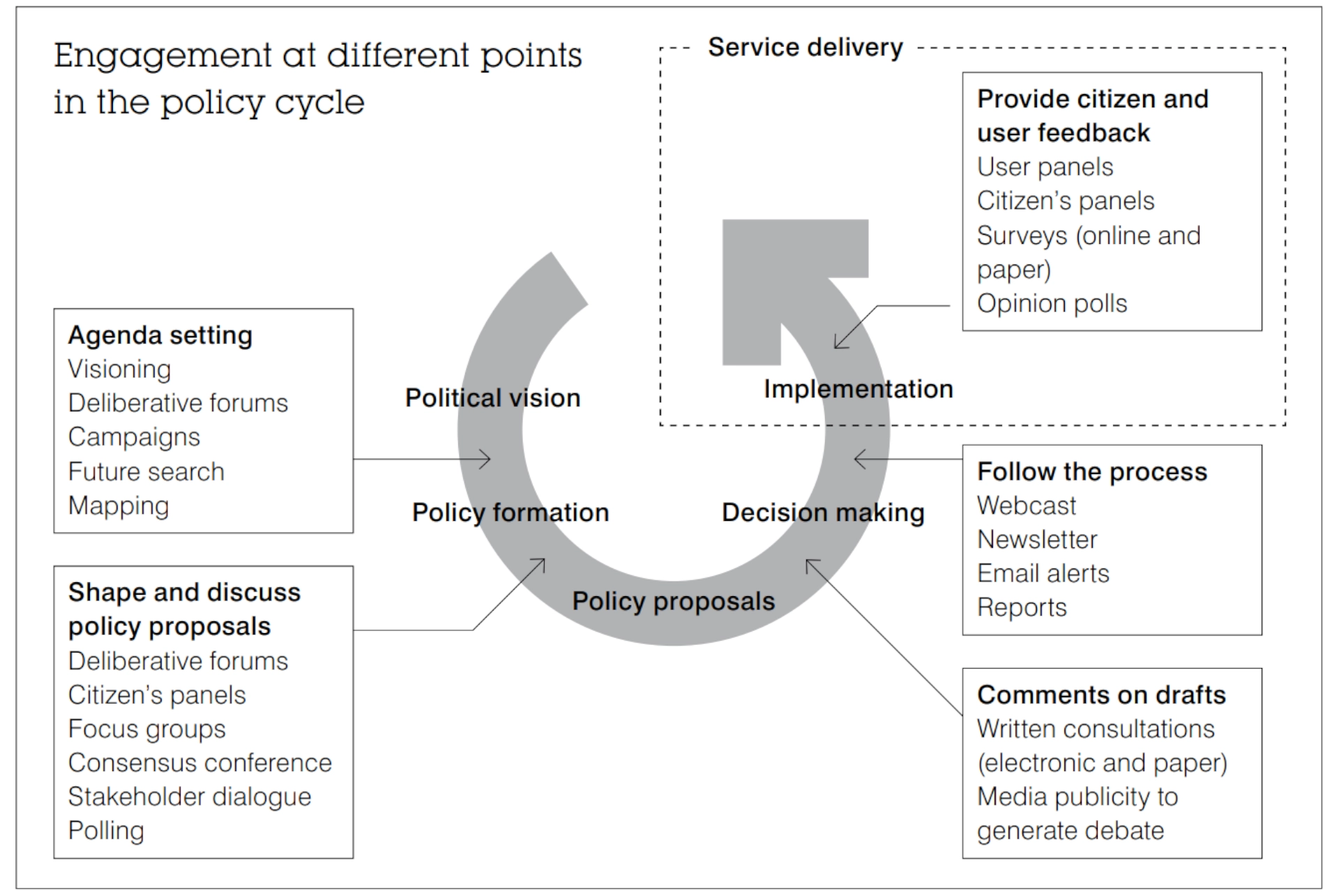
Figure: Engagement at different points in the policy cycle.
STUDIES
2026-04-13
Nature-based solutions insights - Evaluating Citizen Participation: What Works?
Earlier we summarized many ways in which the general public can take part in city design, but how to make it robust, reliable, how to evaluate it? In 2007 in the United Kingdom, researchers Diane Warburton, Richard Wilson, and Elspeth Rainbow developed a study and practical guide examining how public participation in central government decision-making can be evaluated.
Their work tells a powerful, well known story: democracy works better when citizens are not just observers but co-creators of policy. Across many real policy consultations, some involving tens of thousands of participants, the researchers showed that meaningful participation improves decisions, increases transparency, and strengthens public trust.
The authors found that governments increasingly use tools such as citizens’ juries, focus groups, and online discussions to include public voices in policymaking. But participation alone is not enough. The key lesson? Evaluation matters. By setting clear goals and measuring outcomes, institutions can see whether participation actually changes policies, improves decisions, and strengthens relationships between citizens and government.
Think of it like this: when thousands of citizens contribute ideas, experiences, and concerns, policies become grounded in real life, not just theory. The study shows that well-designed participation doesn’t slow democracy down; it actually makes decisions more legitimate, informed, and easier to implement.
Warburton, D., Wilson, R., & Rainbow, E. (2007). Making a Difference: A guide to evaluating public participation in central government. London: Involve / Department for Constitutional Affairs.
https://www.involve.org.uk/sites/default/files/uploads/Making-a-Difference-.pdf