News #9
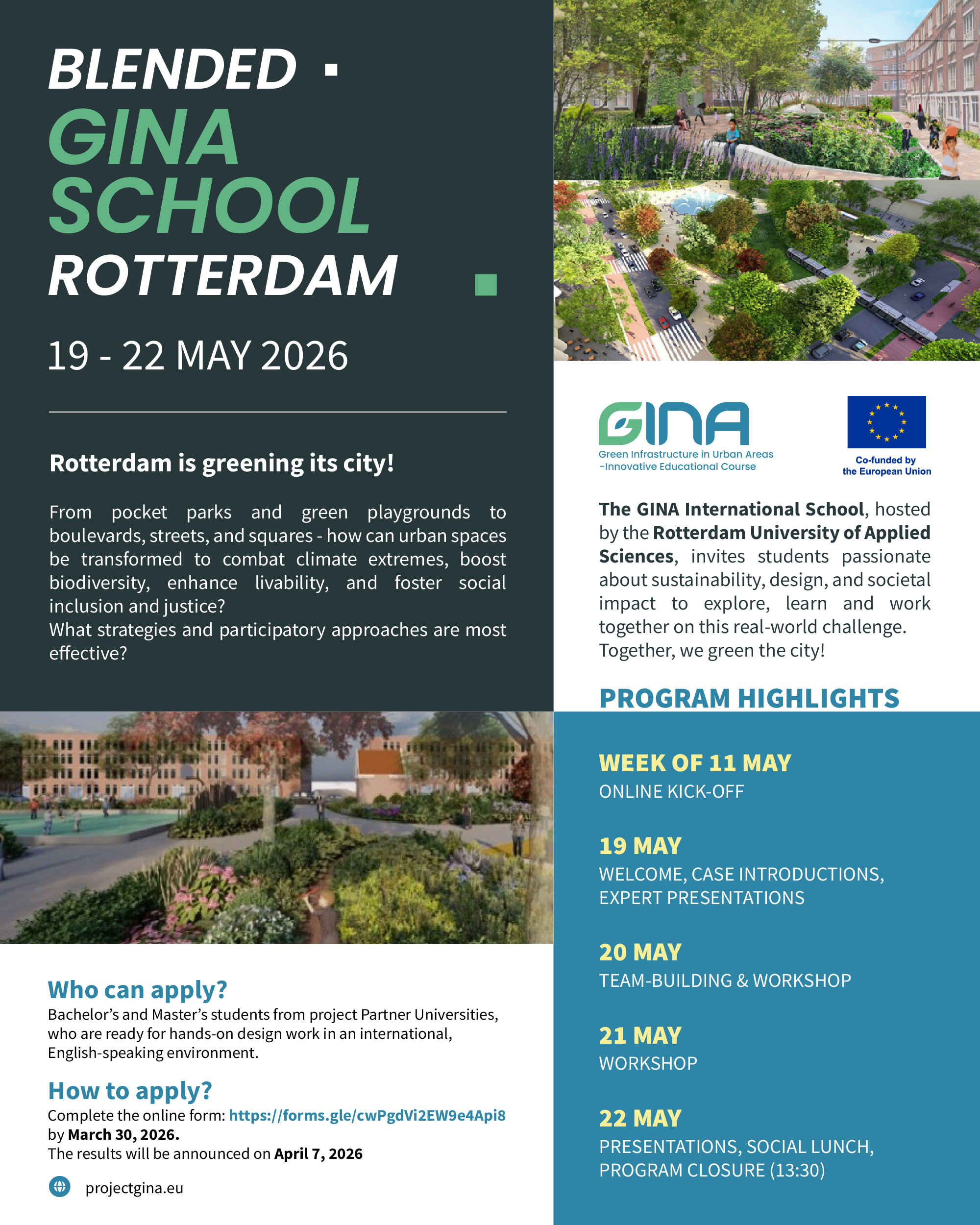
Figure: Own image.
NEWS
2026-03-23
Blended GINA School Rotterdam: Greening Streets and Squares
Date: 19–22 May 2026
Place: Rotterdam, The Netherlands
Rotterdam is greening its city!
From pocket parks and green playgrounds to boulevards, streets, and squares – how can urban spaces be transformed to combat climate extremes, boost biodiversity, enhance livability, and foster social inclusion and justice? What strategies and participatory approaches are most effective?
The GINA International School, hosted by the Rotterdam University of Applied Sciences, invites students passionate about sustainability, design, and societal impact to explore, learn, and work together on this real-world challenge. Together, we green the city!
Program highlights:
- Week of 11 May – Online kick-off,
- 19 May – Welcome, case introductions, expert presentations
- 20 May – Team-building & workshop,
- 21 May – Workshop,
- 22 May – Presentations, social lunch, program closure (13:30).
Contact for registration & info:
Dr. Ted Veldkamp Msc
t.i.e.veldkamp@hr.nl
Who can apply?
Bachelor’s and Master’s students from project Partner Universities, who are ready for hands-on design work in an international, English-speaking environment.
How to apply?
Complete the online form by March 30, 2026. The results will be announced on April 7, 2026. Join us and make Rotterdam greener!