
News #13
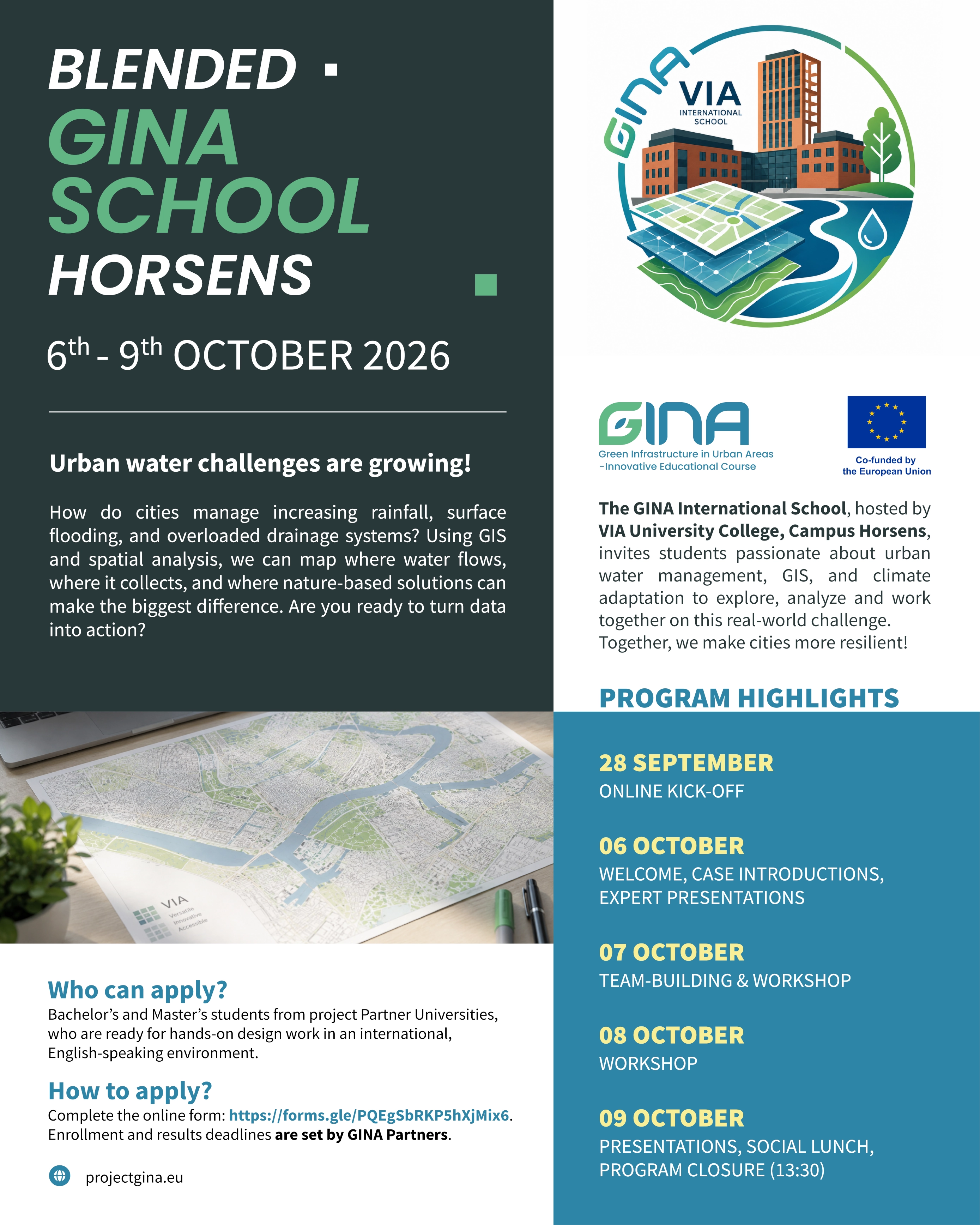
Figure: Own image.
NEWS
2026-06-01
Blended GINA School Horsens: Urban Water challenges are Growing
Date: 06–09 October 2026
Place: Horsens, Denmark
Urban water challenges are growing!
As climate change intensifies, cities face growing challenges related to stormwater management, surface flooding, and pressure on existing drainage infrastructure. How can spatial data, GIS, and nature-based solutions help create more climate-resilient urban environments?
The GINA International School, hosted by VIA University College in Horsens, invites students interested in engineering, environmental sciences, GIS, and sustainable urban development to explore real-world urban water challenges and develop innovative blue-green infrastructure solutions.
Program highlights:
- 28 September – Online kick-off session,
- 6 October – Welcome, introduction to the case study & field-based exploration,
- 7 October – GIS workshops and spatial analysis of urban water dynamics,
- 8 October – Development of nature-based solution proposals and group project work,
- 9 October – Final presentations, discussion, and programme closure.
Who can apply?
Bachelor's and Master's students from GINA partner universities with a background in engineering, environmental science, GIS, or related fields.
How to apply?
Complete the online form