
News #16
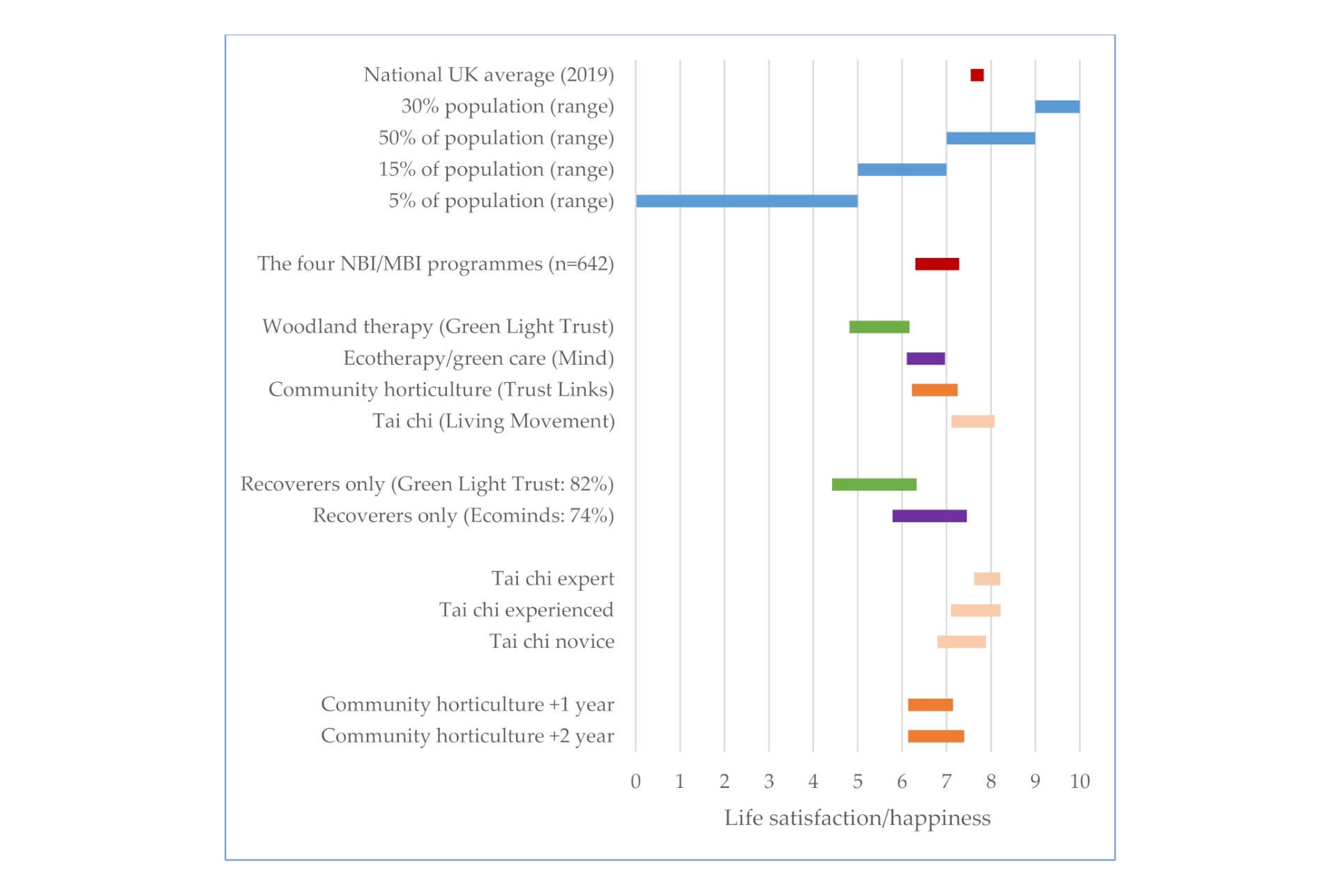
Figure: Margins of improvement of life satisfaction/happiness following four nature-based and mind and body interventions.
NEWS
2026-01-19
What can we learn from science?
Researchers from the University of Essex (UK) studied how nature-based solutions can improve well-being and reduce public health costs. Their team analysed four programmes—woodland therapy, therapeutic gardening, ecotherapy, and tai chi—involving 642 participants across community and health initiatives.
The results were striking. After sustained participation (50+ hours), people reported an average increase of 1 point in life satisfaction on a 10-point scale—a change as big as, or bigger than, many major life events like getting married or having a child! Participants also used fewer GP visits and emergency services, leading to significant public cost savings over time (total economic benefit per person €7,000–€16,400 after 1 year and €10,100–€28,700 after 10 years — equivalent to roughly 2 to 8 years of average per-person healthcare spending in the UK.)! The researchers concluded that nature-based solutions are a powerful “prevention pays” tool: they improve mental health, reduce loneliness, and support healthier lifestyles—while easing pressure on healthcare systems. This means we can learn from them to access green spaces, community gardens, forests, and outdoor activities more often as it can directly support happier, healthier lives, stronger social connections, and more resilient public services. Investing in nature isn’t just good for the planet—it’s good for people and communities.
Pretty, J., & Barton, J. (2020). Nature-based interventions and mind–body interventions: Saving public health costs whilst increasing life satisfaction and happiness. International Journal of Environmental Research and Public Health, 17(21), 7769.
https://www.mdpi.com/1660-4601/17/21/7769